Wednesday, June 3, 2015

Chives Will Never Look the Same Again

Chives are an extremely useful and unfussy garden plant. They are among the earliest plants to emerge in spring; offer a ready supply of green onions through the first mild frosts with almost no tending; self-seed readily but not too aggressively; and put forth these lovely purple flowers in late May and early June. There is also some evidence that they may provide anti-fungal benefits to the surrounding plants.

In short, I like them and have several large plants scattered throughout the garden. And we're now experimenting with moving some of smaller "volunteers" near the apple tees in the orchard.

Still, they might not have gotten their own posting. But after work today, I took a cup of cold mint tea out to a chair in one of the only late afternoon sunny spots in the garden. It's right next to the chives. And my attention was immediately caught by all the movement and buzzing to my right. There were almost a dozen different kinds of bees, wasps, butterflies, beetles and other pollinators concentrated in just a few cubic feet. So I went back for the camera.


Sunday, May 31, 2015

Keeping up with the Asparagus

Too much of a good thing can be ... Asparagus. Richard took me out for dinner for my birthday on Thursday, and then we got dinner at the Ithaca Festival on Friday. So the asparagus got away from us. Last night, we made up for it. With all the various recipes available, our favorite is still pan-roasted in a little clarified butter. When it's fresh, why bother with anything more? 

And no, we didn't finish it, so off to eat the rest for brunch. 


Sunday, May 10, 2015

Before the Fruit Comes the Flowers


A yard full of fruit trees and shrubs is particularly spectacular in May with its profusion of flowers. It's a spring tonic that is especially welcome after a long winter that seemed disinclined to yield to spring. While the timing of each species' flowering is usually spread out over several weeks, many came into bloom at the same time this year, as though the trees simply couldn't wait any longer either. 

Amelanchier (Serviceberry, Juneberry)
The native Serviceberry (Juneberry, Amelanchier) always comes first. On May 6, The Japanese plum burst into bloom overnight, along with the Honeyberry, a Siberian native with small tart dark blue fruit.

Japanese Santa Rosa Plum
Honeyberry

Within a few days, the pear, apple, prune plum, plumcot (an apricot-plum cross) and the first of the peach trees were in bloom as well. So too were the quince and clove current shrubs. 

Flowering Quince
Seckel Pear 

Coral Star Peach
Clove Current

Immediately, our yard was abuzz with pollinators. Although the collapse of the (non-native) honeybee hives threatens the large-scale industrial-agriculture food system and is a disturbing harbinger of the more widespread damage to our environment and ourselves), native bees, wasps and other insects continue to ensure pollination for smaller scale farming. According to Fedco Seeds  (a fantastic source of information about both the work and politics of food growing, as well as a fantastic source of seeds),  it takes 10,000 or more honeybees to do the same amount of pollinating as 250 native mason bees. The native bees fly earlier and later in the day, in colder and wetter conditions, and carry pollen all over their bodies (not just in "pollen baskets" on their hind legs). On the other hand, unlike the social honeybees, it's impossible to corral these solitary dwellers into hives and transport them thousands of miles from farm to farm to pollinate single-species crops. Instead, it's necessary to offer attract them to come and stay with nesting sites (holes in wood or the ground) and a sequential diet of varying food sources spring through fall. (More info from Fedco about attracting native pollinators)

As usual, there are also a large number of bumblebees, which do form social colonies and like the honeybees are in decline more generally due to habitat loss, climate change and pesticides. But with the abundance of these early sources of nectar (and no pesticides), the bumble bees are the first (or at least, the most apparent) of the pollinators at work in our yard. The honey berry (below) seems to be today's favorite. Watching them enter flower after flower after flower, there's clearly a reason for the saying "busy as a bee". 

Honeyberry with bumblebee


Sunday, April 26, 2015

A Walk in Woods

Richard and I took a walk this afternoon to see what was happening in the forest. Over the years, we have sought to reintroduce a number of native species, some of them gifts from the land of family and friends where they were growing in abundance. 

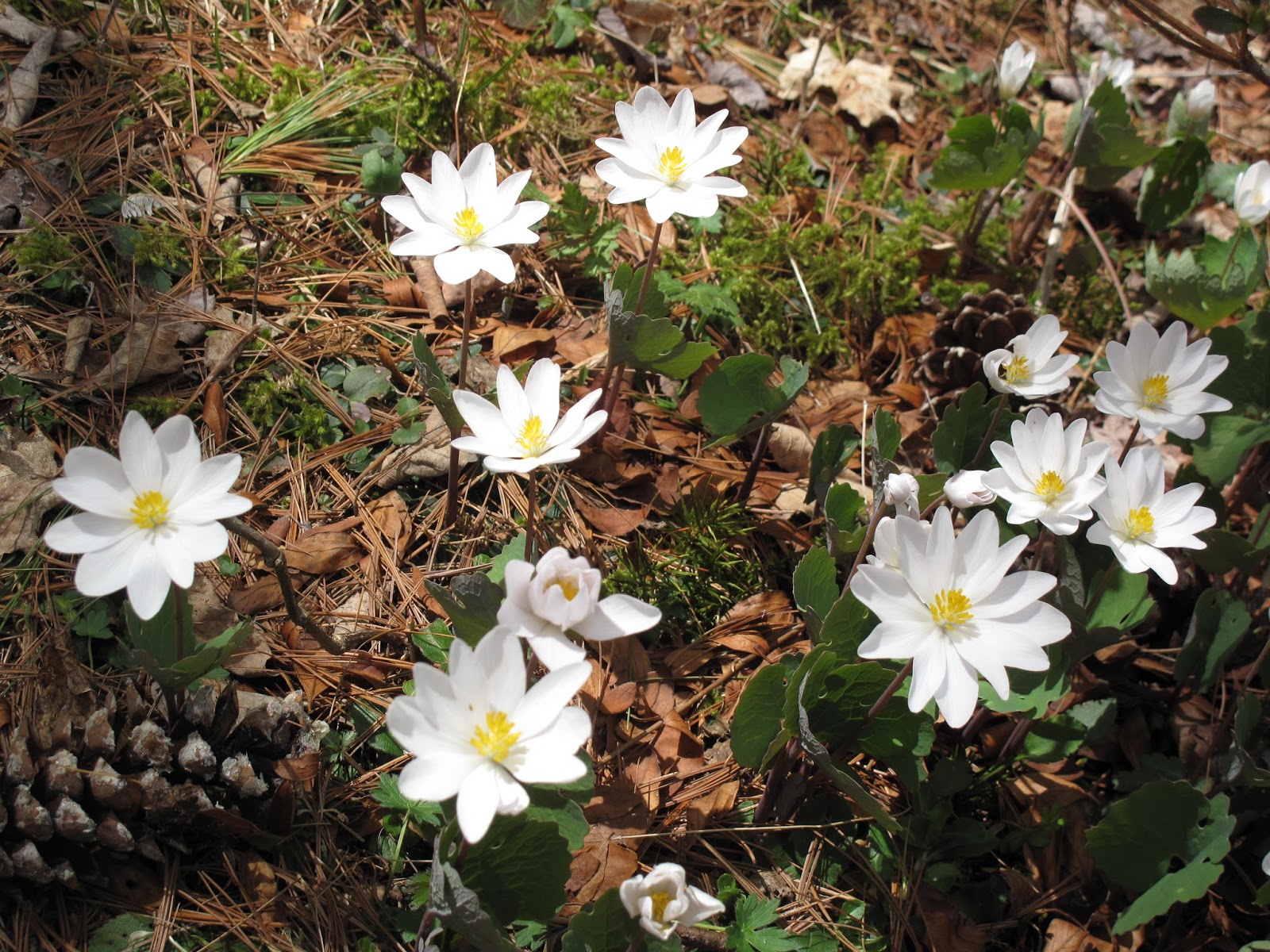
Bloodroot
Bloodroot, with its bright, daisy-like flowers, is one of my favorite early signs of spring. A low-growing, native woodland flower, it takes advantage of the sunlight reaching the forest floor before the trees leaf out. This patch began with transplants from an extensive swath growing along our neighbors' stream, and I'm happy to see it beginning to spread. It's not edible, but it certainly feeds the spirit.

Wild onion
Richard transplanted these wild onions from a patch growing near the stream at his parents former home (now his sister's home), placing them on the banks of our stream.  One of many members of that allium family that naturalize, they are small, but tasty. They can be dug for use like a scallions (below), but more frequently, we simply nibble on the greens as we pass by.

Wild onions (2010 photo)
Wild leeks, or ramps, are another naturalizing member of the allium family native to eastern North America. A slow-growing, "gourmet" treat, formerly abundant colonies have been over-harvested in many places. But Richard's uncle still has a hillside full, where these came from. In Perennial Vegetables, Eric Toensmeier describes ramps as one of the few shade-loving vegetables "really worth growing." It will be still be another few years before we can begin to harvest more than a leaf or two, but we were glad to see that some of the bulbs had doubled in the last year. 


Wild Leeks (Ramps)

Wednesday, April 15, 2015

More Survivors

"North Pole" Lettuce
This "North Pole" lettuce (from Fedco Seeds) certainly lived up to its name. I planted this batch last fall, and they overwintered in the hoophouse (with its below zero temperatures),  protected only by an additional cloth row cover. We lost the oldest frozen leaves, but the roots remained strong, and the new growth has accelerated with the longer spring days.


Friday, April 3, 2015

Bitter herbs


Here it is early April, and we still have widespread snow cover. So I went digging for the horseradish. What I found was a determination for spring as fierce and fiery as my own.


Monday, March 30, 2015

Survivors!

Hoophouse (Feb. 16)
The tenacity of life is astounding.

While the rest of the planet was experiencing warmer than average temperatures, the northeast U.S. had one of its coldest winters ever. Outside Ithaca, NY, where we live, we had multiple nights with temperatures falling below 0 degrees F, even multiple nights with temperatures falling into the negative teens. We recorded a low of -2.7 degrees in the high tunnel (unheated hoophouse).


Fortunately, the deep snow cover and consistently below freezing temperatures helped prevent repeated freezing and thawing. But it was still a "zone 4" winter in a place that is typically "zone 5." And we didn't get around to providing extra mulch, doubling the row covers, or doing anything except waiting to see what survived. And while our March crops were nothing like the previous years, here is some of what we found:

High Tunnel Spinach (March 9)

Carrots and radishes dug from the hoophouse (March 9)

Low tunnels protected only by a single row cover (March 29)
Low Tunnel Tatsoi (March 29)

Low Tunnel Mache  (March 29)


Low Tunnel Spinach (March 29)


The challenge will be how to farm in face of climate chaos. For years, the conventional wisdom has been to look to and learn from those farming one zone warmer. But our frigid winter resulted from the changes in the shape of the arctic air front -- a wave pattern with now greater amplitude (the high and low points of the wave) as a result of global warming. As warmer air pushes into the arctic, some of the colder air mass is pushed further south. But where it descends will vary unpredictably from year to year. So while we will have many zone 6 winters (and summers), requiring crops that withstand warmer temperatures, we will also apparently have zone 4 winters (and summers) with colder temperatures and shorter growing seasons as well. And so the experimentation with sustaining life continues.